
Individual original-sheet review and purchasing analysis; no physical rammer, compaction or noise/vibration test.
ACE CT-78DA diesel tamping rammer
CT-78DA is the diesel configuration in ACE’s original four-model rammer sheet. Its machine references help frame an enquiry; they do not establish achievable soil density, production rate or the current delivered revision.
Use CT-78DA’s row, not a neighbour’s engine
The original sheet combines four models in one table.
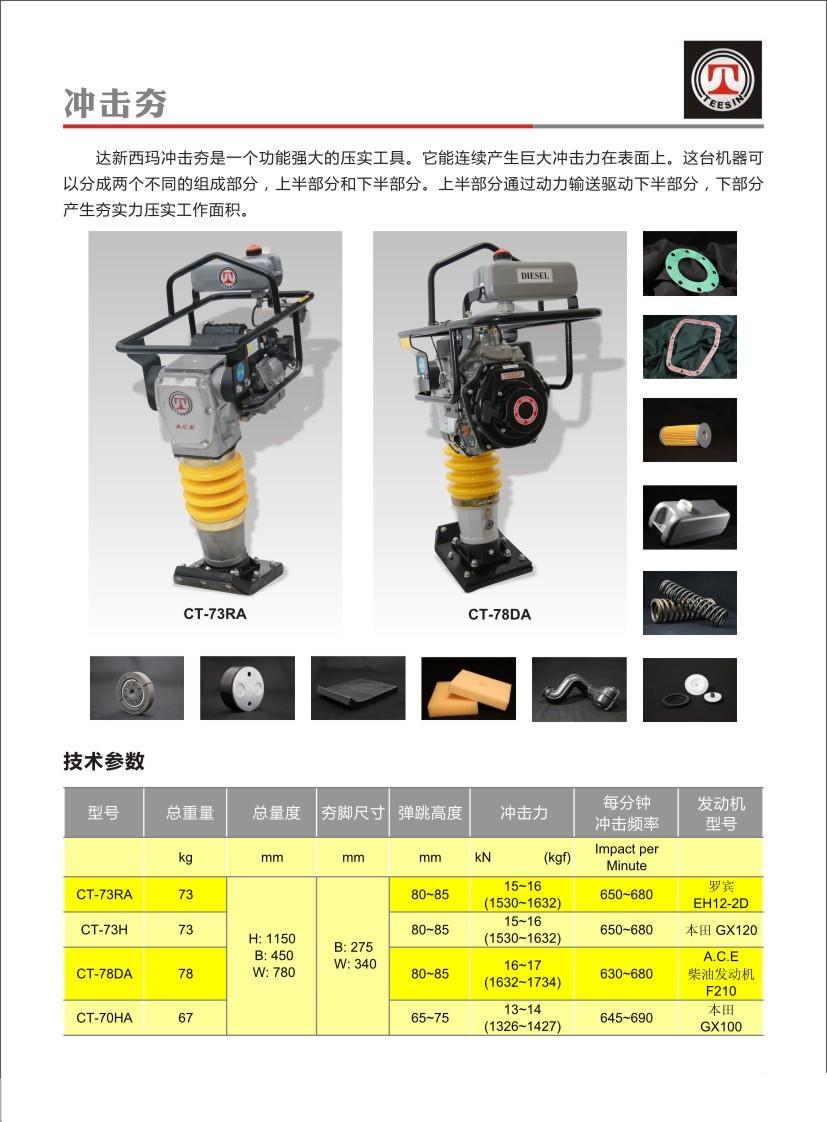
ACE’s separate CT-78DA listing identifies the model but offers little additional technical content. The readable specifications are in the original generic rammer page’s full image. [1][3] Its table assigns A.C.E F210 diesel to CT-78DA; Robin EH12-2D, Honda GX120 and Honda GX100 belong to other model rows. No Honda or Robin configuration is attributed to CT-78DA here.
| Item | Original-sheet value and boundary |
|---|---|
| Total weight | 78 kg; working/shipping mass convention is not defined |
| Overall dimensions | H 1150, B 450, W 780 mm, in a shared table cell; confirm the current dimensional drawing and axis convention |
| Foot dimensions | B 275, W 340 mm, in a shared table cell; orientation and attachment drawing to confirm |
| Jumping height | 80–85 mm; no stated test conditions |
| Impact force | 16–17 kN; no measurement method or soil-condition basis |
| Impacts per minute | 630–680; this is not handle vibration acceleration |
| Engine | A.C.E F210 diesel; power, speed and current emissions configuration not supplied |
The sheet gives the force again in kgf; that is a force expression, not a second machine weight or load rating. These published entries are not CivilEquip test results. The image has no explicit revision date, and its file path includes a 2015 timestamp; that filename alone does not establish the manufacturing date or present availability.
Open the full original four-model sheet ↗Ask whether it can meet the job’s acceptance
Force and frequency do not give a density result.
A procurement brief should identify the fill specification, moisture condition, layer requirements, working width and the project’s acceptance/test method. The source does not publish achieved density, validated lift depth, passes per layer, travel speed or area per hour. Do not multiply foot area by impact frequency to invent production capacity.
For a defined site task
Send the material and access constraints and ask the supplier for a justified model proposal. Confirm the foot’s actual orientation and machine envelope against the working space; a 275 mm table dimension is not automatic permission to work in a trench of that width.
For a repeated fleet purchase
Identify the existing machine revision and accepted performance records. Agree a controlled demonstration and the inspection requirements for the new shipment rather than treating a familiar model code as proof of unchanged components.
Operating instructions and a qualified site assessment govern safe use and compaction acceptance. This catalogue review is not a construction procedure, trench-access approval or instruction to choose a particular layer thickness. CivilEquip has not compacted or tested soil with CT-78DA.
Freeze the diesel engine and service configuration
The F210 label needs a current engine specification.
The right-hand source photograph marks the tank “DIESEL”; the CT-78DA row identifies A.C.E F210. [2] The sheet does not establish rated power, governed speed, start arrangement, fuel/oil capacities or destination emissions compliance. Ask for the actual engine identification plate, current manual and required conformity documents.
Have the quote state whether the engine and controls match the pictured configuration and explain any changes. Different engine versions can carry different service references; do not order a neighbouring model’s filter, recoil part or engine manual on visual similarity alone. No equivalence to a branded engine is asserted here.
What should the current package description add?
Engine variant and serial identification, start/control arrangement, rammer/foot revision, transport provisions, included accessories, English operation/maintenance instructions, relevant inspection records and the destination-specific documents required for the transaction.
No reviewed source defines allowed storage/transport orientation, a lifting point or a shipping procedure. Request the manufacturer’s instructions for the actual machine and its stated packed net/gross masses. The 78 kg entry alone cannot provide a lifting or handling plan.
Request usable vibration and noise information
630–680 impacts/minute answers a different question.
HSE identifies compactors among vibrating construction equipment and recommends obtaining supplier information relevant to the work and exposure assessment. [4] Ask for CT-78DA handle-vibration acceleration, uncertainty, test standard and operating conditions, together with noise data and the current instructions.
The reviewed sheet contains no handle acceleration or noise measurement. Its impact count cannot be converted into those values, and photographs cannot establish effective vibration isolation. No safe daily operating time or “low-vibration” rating is assigned.
Use applicable site requirements and qualified assessment for operation, exhaust, handling and exposure controls. Equipment selection and maintenance evidence belong in the purchase; a general claim of comfort or quality cannot replace model-specific data.
Receive the spares map, not just pictures of parts
The original sheet illustrates components without order codes.
Bellows, filters, a foot-like part, springs and other components appear beside the machine images. [2] The source does not map them to CT-78DA by part number or explain interchangeability among the four models. Request an exploded drawing and a revision-specific service kit list.
- Identify: record machine and engine codes/revisions with the supplied manuals.
- Approve: agree inspections and any job-relevant demonstration before shipment.
- Match: check actual nameplates, accessories, parts references and documents against the quotation on receipt.
- Retain: preserve serials, invoice, packing and required inspection records for repeat spares or a warranty claim.
The reviewed pages provide no fixed price, stock, dispatch date or complete warranty. Ask the ACE supplier to identify manufacture/import responsibilities, spare availability and written support terms for this order. Source artwork includes ACE and TEESIN marks without reviewed ownership/authorisation evidence; obtain the actual delivered brand and legal manufacturer.
Request a current CT-78DA offer
Edit the job information and retain the missing-data questions.
Sources & review
- Original ACE rammer page ↗
Full four-model specification image in description; parameter/features tabs contain no additional detailed values.
2026-10-11 - Original rammer specification image ↗
Full image visually read. CT-78DA row plus shared dimensions/foot; illustrations do not provide spare-part codes or a dated revision.
2026-10-11 - Separate original CT-78DA catalogue entry ↗
Confirms model listing; reviewed entry does not add a complete current specification or working manual.
2026-10-11 - UK HSE: construction vibration ↗
General exposure-assessment context and supplier-information requirements; no CT-78DA measurement or safe duration supplied.
2026-10-11
Specifications come from the manufacturer’s published information and the sources above; buying advice is written by CivilEquip with AI assistance. Ask the manufacturer to confirm the data for your configuration. Editorial policy · Report a correction.