
Individual review of the original two-model sheet with PE industry guidance. No hands-on machine or joint test.
Xuansheng XS-YH315 / XS-YH355 butt-fusion machines
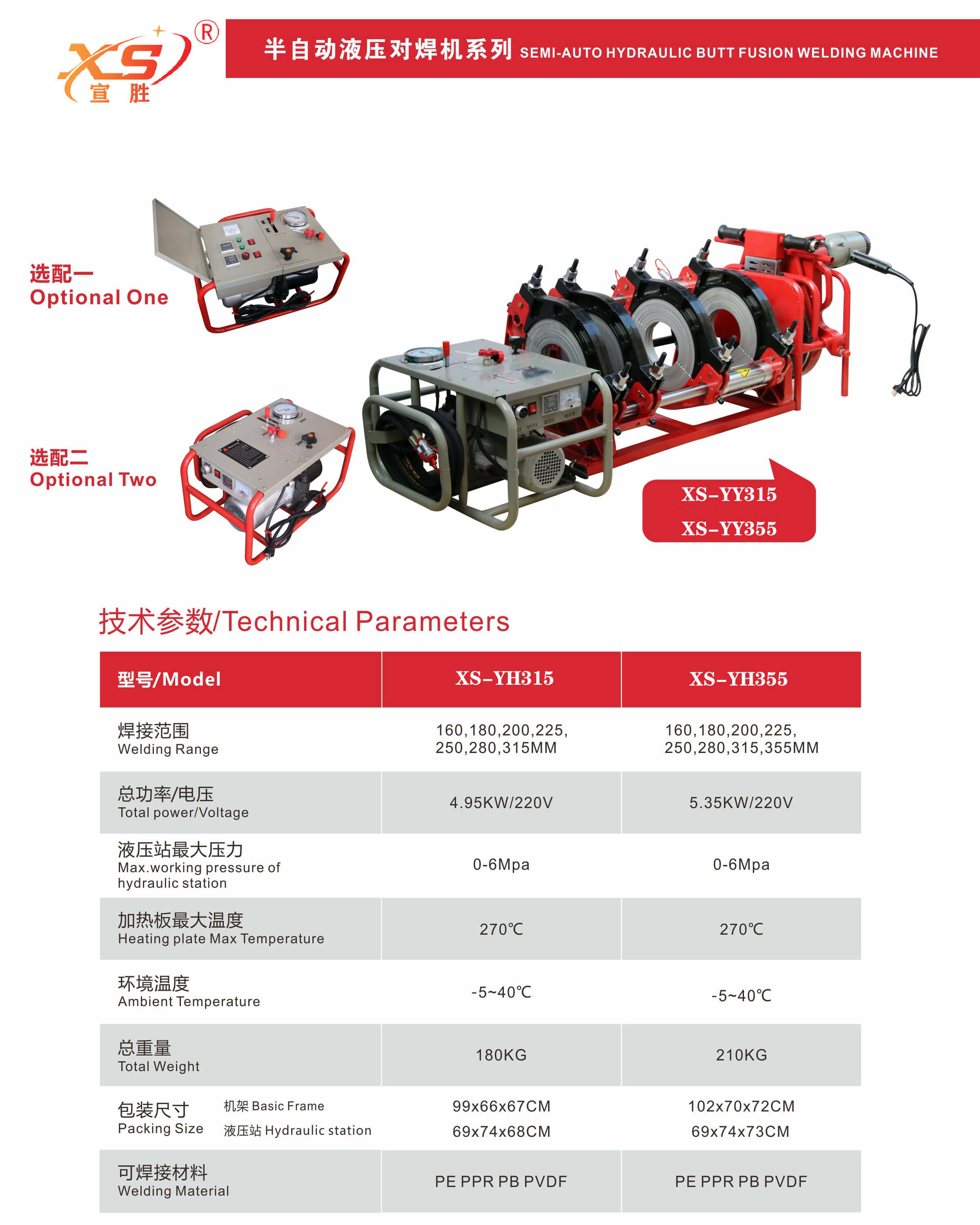
Two semi-auto hydraulic butt-fusion configurations share seven listed pipe sizes; the YH355 sheet adds 355 mm. Confirm actual machine codes, tooling and project procedure before selecting the package.
The original sheet, translated into selection data
Each column describes a configuration; do not combine them into one specification.
Xuansheng places this pair in its semi-auto hydraulic butt-fusion category. The parameter headings read XS-YH315 and XS-YH355. [1][2] The following values are supplier-published references, not CivilEquip measurements or a verified conformity report.
| Parameter | XS-YH315 | XS-YH355 |
|---|---|---|
| Listed pipe sizes (mm) | 160, 180, 200, 225, 250, 280, 315 | 160, 180, 200, 225, 250, 280, 315, 355 |
| Total power / voltage | 4.95 kW / 220 V | 5.35 kW / 220 V |
| Hydraulic station working-pressure range | 0–6 MPa | 0–6 MPa |
| Heating-plate maximum | 270°C | 270°C |
| Ambient temperature | −5 to 40°C | −5 to 40°C |
| Total weight (scope unspecified) | 180 kg | 210 kg |
| Basic-frame packing (cm) | 99 × 66 × 67 | 102 × 70 × 72 |
| Hydraulic-station packing (cm) | 69 × 74 × 68 | 69 × 74 × 73 |
| Materials listed by supplier | PE, PPR, PB, PVDF | PE, PPR, PB, PVDF |
The diameter entries are a discrete list. They do not establish every intermediate diameter, included reducer quantity, pipe wall/DR range or suitability for every grade of the named polymers. A pipe marked 355 mm points to the larger published configuration, but still needs tooling and process approval. For a project using only the seven shared sizes, compare the complete package and handling needs before selecting the larger frame.
Inspect the full original supplier sheet ↗YH in the table, YY on the photographs
A real discrepancy that belongs in the quotation.
The webpage selection and table use XS-YH315 / XS-YH355, while the red labels in the equipment pictures read XS-YY315 / XS-YY355. The reviewed material does not explain whether these are older labels, related models or an illustration error. This page keeps the discrepancy rather than declaring them equivalent.
Request a current dated sheet and photographs of the actual frame and station identification plates. Have the quotation, bill of supply, manual and applicable declaration identify the same configuration. The image also shows “Optional One” and “Optional Two” hydraulic units without explaining the difference or assigning a separate option code. Do not infer that either is included, interchangeable or functionally identical.
Ask the supplier to describe which operations are controlled automatically. The category name does not establish automatic cycle execution, pressure logging, barcode functions or printed joint records. If the project requires those capabilities, obtain model-specific evidence before comparing this package to a fully automatic system.
Machine ceilings are not welding settings
Separate hydraulic capacity, interface pressure and the qualified procedure.
0–6 MPa: hydraulic station
This is the station range printed in the sheet. It is not a recommended pipe-interface pressure or proof of pipe pressure rating. The source omits effective cylinder area and pressure-calculation instructions.
270°C: plate maximum
This is the published heater ceiling. It is not a universal operating temperature for the listed materials and does not establish control accuracy or surface-temperature uniformity.
PPI explains that machine gauge pressure and pipe interfacial pressure are different quantities; the conversion depends on pipe geometry, effective hydraulic cylinder area and drag. [4] Require the machine-specific calculation method and calibration evidence. No setting is calculated from the 6 MPa limit here.
PPI TN-51 discusses controlled PE preparation, heating, joining and cooling and presents differing procedure contexts. [3] Use the procedure accepted for the actual project, pipe/fitting system and trained crew. That PE reference does not qualify PPR, PB or PVDF work. Neither a shared heater maximum nor a polymer name is a validated joining recipe.
Ask for the missing operating evidence
Effective cylinder area, gauge range/resolution and calibration, drag-pressure method, heater-control checks, instructions for the supplied station, accepted pipe dimensions/materials and procedure-specific operation. Ask how the proposed package records the parameters the project requires; do not assume a data logger is present.
Reducers, power and handling decide site usability
Compare delivered packages, rather than nominal diameters alone.
| Order question | Required clarification |
|---|---|
| Which reducer inserts arrive? | Identify inserts for every required OD, their quantities and frame compatibility; a size listed in a table is not a packing list. |
| Can the site supply run it? | Confirm phase/frequency, heater/facer/station power breakdown, connectors and start-up requirements. The sheet gives only 220 V and total power. |
| How will pipes and tools be supported? | Identify supports, handling provisions, facer/heater stands and usable clamping space. Agree the arrangement against actual pipe length and work area. |
| What is being shipped? | Obtain package count, contents and net/gross masses. The “total weight” scope and two packing-size entries do not resolve freight or lifting arrangements. |
The published ambient range is not an enclosure/IP rating or evidence that a weld made in rain, wind or contamination is acceptable. Ask for operating restrictions and site-protection instructions. Keep machine-environment limits separate from process controls and project safety arrangements.
Accept the configuration and the process separately
A machine demonstration is useful when its inputs are identified.
- Equipment identity: resolve YH/YY naming and station options; approve the current configuration and tooling list.
- Inspection evidence: agree frame/alignment, facer, heater and gauge checks, manuals and required calibration documentation.
- Procedure demonstration: identify pipe material/OD/DR, operator, settings and accepted procedure. Agree required records and joint evaluation with the responsible project team.
- Delivery handover: match serials and accessories, retain documents and agree spare-part/service responsibilities before site mobilisation.
Visual bead appearance alone cannot establish all internal joint quality; the reviewed PPI discussion explicitly describes that inspection boundary. [3] CivilEquip has not welded, pressure-tested or destructively examined a joint made by either machine. There is no validated field productivity, joint-success rate, price, stock or delivery promise on this page.
For supplier identity, the 2010 history claim, registered incorporation-date difference and manufacturing scope, see the separate Xuansheng factory review. Factory-level CE wording is not a model-specific conformity result.
Request the correct 315/355 package
Edit the pipe and site requirements before transferring the brief.
Sources & review
- Xuansheng official product centre ↗
Select 半自动液压对焊机系列, then XS-YH315/XS-YH355. The shared route defaults to a different model after reload.
2026-10-11 - Original 315/355 sheet image ↗
Full image read, including both parameter columns, two station options and conflicting YY photo labels. No dated revision or test report.
2026-10-11 - PPI TN-51, revised April 2026 ↗
Relevant PDF pages 4, 5 and 16 visually read for PE process and inspection boundaries. Not this machine’s operating procedure.
2026-10-11 - PPI Municipal Advisory Board: Join / Hold ↗
Public explanation of interfacial force, drag and hydraulic pressure, and cooling under force. No machine-specific settings.
2026-10-11
Specifications come from the manufacturer’s published information and the sources above; buying advice is written by CivilEquip with AI assistance. Ask the manufacturer to confirm the data for your configuration. Editorial policy · Report a correction.